Horse nosebleeds, or epistaxis to give them the correct name, are a common issue in all types of horses, there are many different causes for nosebleeds in horses and sometimes the reason is not known, what we know for sure though is that when they do happen, due to the size of our equine friends, they can look very dramatic!
Nosebleeds in horses can vary from a minor bleed to a more severe bleed that will require urgent and sometimes emergency equine veterinary attention. Our equine vets are experienced and well equipped at diagnosing and treating horse nosebleeds. If you have noticed a bleed from one or both of your horses nostrils, contact our practice by calling 01295 670 501 and one of our equine vets will be able to advise you further. If your horse is within our coverage area, which includes most of Oxfordshire, Warwickshire, Northamptonshire parts of Gloucestershire, Worcestershire, Birmingham, The Midlands and The Cotswolds, we can help you look after your horse with our high standards of routine and emergency care for equines.
In this article, we outline the causes of horse nosebleeds, their diagnosis and the key treatment options.
Causes Of Nosebleeds In Horses
The causes of nosebleeds in horses are variable, just as they are in humans. While some cases can be minor others are more serious and can require urgent veterinary attention. In many cases, the cause can be narrowed down by whether the bleeding is coming from one or both nostrils.
Burst Capillary (Small Blood Vessel)
Minor horse nosebleeds at work or after excitement can be simply due to a burst capillary (small blood vessel) in the nose, usually from just one nostril, these are not concerning, usually clear up of their own accord and don’t often recur. They are the least serious form of nosebleed in horses but can still require equine veterinary attention in some cases.
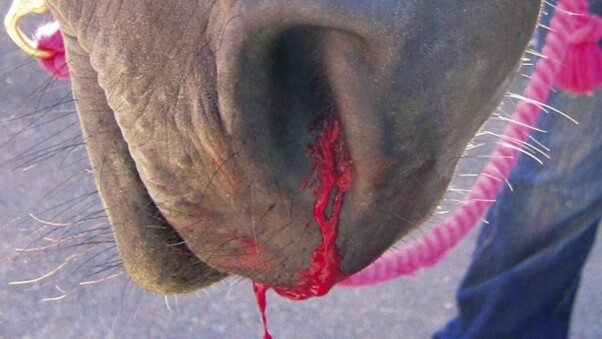
Minor Nosebleed
Exercise Induced Pulmonary Haemorrhage (EIPH)
Exercise Induced Pulmonary Haemorrhage (EIPH) is another prominent cause of nosebleeds at exercise. EIPH usually occurs during galloping work and is commonly seen within the racing and eventing disciplines. It often causes minor nosebleeds from both nostrils.
The cause of EIPH is thought to be a combination of high blood pressure in the lungs, inflammation in the lungs, shearing forces of strenuous exercise and the fragile capillaries within this tissue. EIPH is often a recurrent problem and you should consult your equine vet for investigations and a management plan, adapting training techniques can sometimes help reduce instances of EIPH.
Equine Head Trauma
Equine head trauma is another common cause of equine nosebleeds.There are numerous blood vessels within a horse's head and nose and if any of these are damaged due to a bang to the head, the bleeding tends to drain via the nostrils. The severity of the bleeding depends entirely on which structures have been damaged.
Direct trauma can also be caused by equine vets, these instances are known as iatrogenic epistaxis, this is a relatively common complication of passing a stomach tube, gastroscope or endoscope. While we take many precautions to prevent this from happening, such as sedating the horse where necessary, adjusting the size of tube used, applying lubrication to the tube and careful driving of scopes, sometimes, and especially if a horse moves or shakes his head at the wrong moment, a horse nosebleed sometimes can’t be avoided. This is due to the many blood vessels in the nose and upper airways of a horse.
Ethmoid Haematomas
Ethmoid haematomas are a rare cause of nosebleeds, and we are not sure exactly why they form. They are a benign mass associated with the delicate and well vascularised ethmoid turbinates within a horse’s airway. They are locally destructive and will cause nosebleeds from the nostril on the affected side of the head.
Guttural Pouch Mycosis
Guttural pouch mycosis is another thankfully rare, yet extremely serious cause of nosebleeds. We often think of strangles when we think of guttural pouches, but these warm and damp air-filled cavities on either side of a horse’s head can also be a perfect home for fungal plaques to grow.
Some pretty important structures such as the carotid arteries run through the guttural pouches, if fungal plaques make their home on the wall of the carotid then they can eat through the wall and cause catastrophic bleeding. This is a potentially life-threatening equine nosebleed and is an emergency that requires immediate veterinary attention.
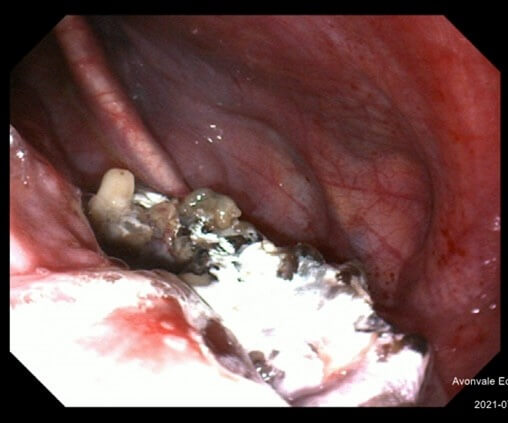
Fungal Plaque Within A Guttural Pouch
Diagnosis Of Horse Nosebleeds
In order to investigate and diagnose horse nosebleeds, the first step that we take is to get the full history from you, the horse’s owners. It is very useful if you can keep a diary of when nosebleeds have occurred, recording what the horse was doing when it happened, and how severe they are (pictures or videos are particularly useful!), which nostril it was or if it was both nostrils. Taking note of any other clinical signs such as snotty noses, coughs or being generally under the weather.
The first thing we often do to investigate equine nosebleeds is to use an endoscope to look at the inside of the nostrils, upper airways and trachea to see if we can detect where the bleed has come from, sometimes this will involve taking a sample of fluid/a wash from the trachea/ lungs to check for recent bleeding there. We will usually try to carefully examine the guttural pouches, especially if the horse has a history of moderate or severe one sided bleeding.
If nothing is found on the equine endoscopy, we can also use x-rays to look at the sinuses and can sometimes detect an ethmoid haematoma this way. If nothing at all is found from the endoscopy or x-rays but the bleeding is continuing, a CT scan may be required to further image the structures of the head.
Treatment Of Equine Nosebleeds
The treatment for most minor equine nosebleeds typically involves keeping your horse as calm and quiet as possible and waiting for the bleeding to stop. If we identify the cause of the nosebleed as an ethmoid haematoma or guttural pouch mycosis, these causes can be treated by an equine vet.
Ethmoid Haematomas
Ethmoid haematomas can sometimes be surgically removed, or we sometimes opt to drain them and instill formalin to prevent them from reforming, however this is not always successful and they can re-form.
Guttural Pouch Mycosis
Guttural pouch mycosis is usually fatal if not treated, if guttural pouch mycosis is identified then your equine vet will want to treat, or refer to an equine veterinary hospital for treatment as an emergency case. If your horse is actively bleeding or has recently bled then surgery is required to tie off the bleeding vessels. Anti-fungal solutions can also be instilled into the guttural pouch to try and kill the fungus that has caused the damage to the vessels.
Unfortunately, because it is hidden away in the head with usually no symptoms, guttural pouch mycosis is often not detected until it is too late, so any moderate or severe equine nosebleed of unknown origin should be treated as an emergency. If your horse has a moderate or severe nosebleed, contact your equine vet immediately for further advice.
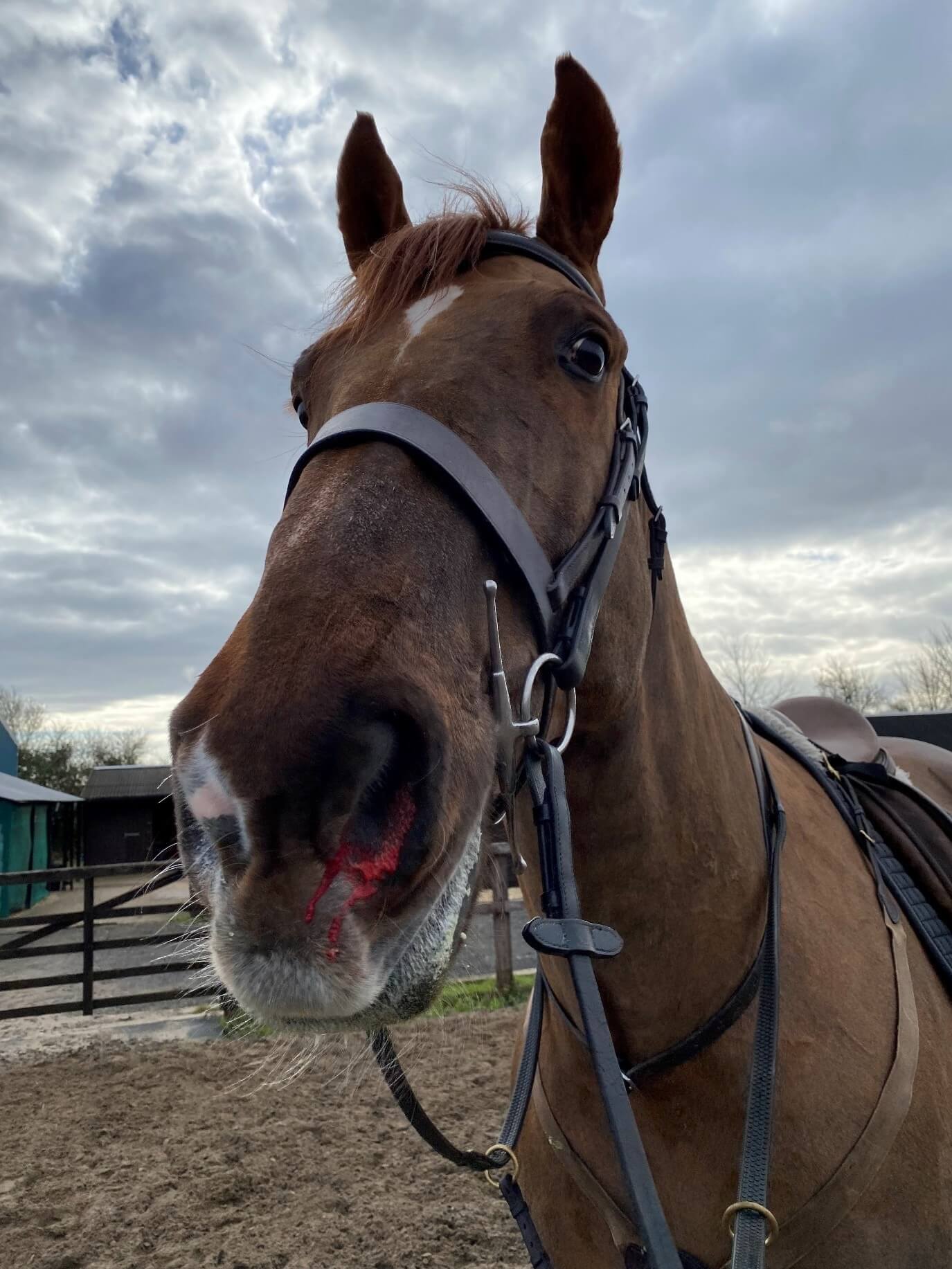
What To Do If Your Horse Has A Nosebleed
Please don’t panic! Try to keep your horse calm and quiet, ideally in their stable for monitoring. Note down which nostril he is bleeding from, what time the bleeding started and how profusely he is bleeding, it can be helpful to take a picture or a video to show your equine vet.
If the bleed is just a small drip or stream and stops within a few minutes then it is likely that your horse has just burst a capillary in his nose, but be sure to monitor him for further bleeds.
If he is bleeding profusely and it does not stop within a few minutes then it is a good idea to call your equine vet for advice. If your horse is standing still it can be helpful to pop a bucket under him to catch the blood, or otherwise to leave him where he is and not clean the blood up yet so that we can see how much bleeding there has been.
Diagnosis And Treatment Of Horse Nosebleeds At Avonvale Equine
At Avonvale Equine, our equine vets are experienced at diagnosing and treating horse nosebleeds. If your horse has moderate or severe nasal bleeding, a nosebleed that doesn't stop after a few minutes or you are at all concerned about your horse and you are within our coverage area, please contact us on 01295 670 501 to speak to one of our reception team or equine vets.
Our coverage area includes large parts of Oxfordshire, Warwickshire, Northamptonshire, Birmingham, The Midlands as well as areas of Worcestershire, The Cotswolds, and Gloucestershire.
Register Your Horse/s At Avonvale Equine
If you are looking for a new equine vet for your horse/s that delivers excellent routine and 24/7 in-house emergency care, why not get in touch with us?
Our experienced and skilled equine vets are passionate about helping both equine businesses and individual owners look after their equines through delivering the highest standards of equine healthcare.
To register your horse with us, complete our new client registration form online or call our practice on 01295 670 501.